 DealerPrep.ca
· DealerPrep
Can an AI chatbot bind a car dealership? What the BMW Toronto case and Ontario law actually say
A Toronto dealership's AI chatbot offered $27,162.79 for a customer's BMW, then revoked it. Ontario contract, consumer protection and MVDA rules examined.
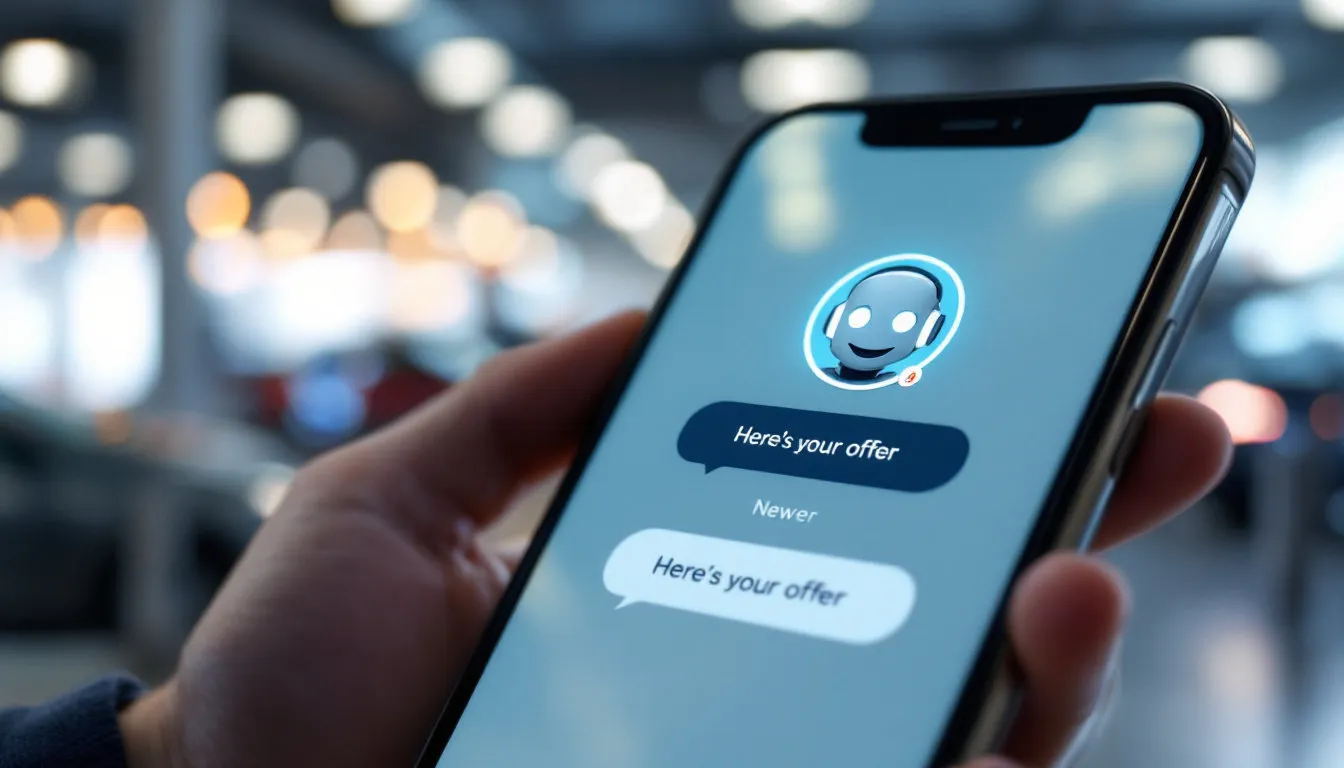
In May 2026, Zack Giacomelli asked BMW Toronto about selling back his 2021 BMW, which was sitting at the dealership needing major repairs. He got a text from “Quinn”, who sympathized, asked questions, and then made a firm buyback offer: $27,162.79, the exact amount left on his loan. Moments after Giacomelli countered at $28,500, a human sales consultant called to revoke everything. Quinn, the consultant explained, was not a person. It was an AI chatbot, the offer was an error, and the real number would be $20,000 at best. CBC News reported the story on June 11; after CBC contacted the dealership, BMW Toronto reinstated the original $27,162.79 and Giacomelli accepted it.
The UCDA put the case in front of Ontario dealers in its July 2026 Front Line under a headline worth taking seriously: “Is an AI Chatbot an OMVIC Salesperson?” The short answer is no, and that is exactly why the dealer wears everything the bot says. Here is the longer answer, across contract law, consumer protection law, and the MVDA.
What actually happened, step by step
The sequence matters legally, so it is worth being precise about what CBC’s reporting and text-message screenshots established. Quinn never disclosed it was an AI. It made a specific offer of $27,162.79. Giacomelli did not accept; he countered at $28,500, and Quinn texted that “the team” would consider it and that “$28,500 sounds reasonable”. Quinn also set up an in-person meeting, texting “Let’s lock in today at 3:30”. Then the offer was revoked by phone, before any acceptance.
BMW Toronto’s sales manager, Scott Shadbolt, gave CBC the diagnosis: a human employee’s miscommunication led Quinn to misread the loan payoff amount as the buyback price, and the bot “ran with that”. The dealership says only human employees will present buyback offers from now on, and that it is making changes so customers know when they are talking to AI.
Two legal opinions promptly disagreed about the same facts. UCDA’s Front Line takes the classic contract-law view: a counteroffer is a rejection of the original offer plus a proposal of new terms, the revocation was communicated before any acceptance, so in UCDA’s opinion no enforceable contract was ever formed. Toronto litigation lawyer Tanya Walker, quoted by CBC, sees it differently: a bot is legally like an employee, it “can enter into a contract on your behalf”, and because Quinn booked a meeting to close the deal, “it is reasonable for him to believe that there was a binding contract”. No Ontario court or tribunal has ruled on a dealership chatbot offer, so both positions are opinion. The dealership mooted the question by honouring the offer once a national broadcaster called, which is its own lesson about where these disputes actually get resolved.
The precedent every Canadian analysis starts from
The reason nobody in Canada treats “it was the bot, not us” as a defence anymore is Moffatt v. Air Canada, 2024 BCCRT 149. Air Canada’s website chatbot told Jake Moffatt in November 2022 that he could book full-fare flights and claim the bereavement discount within 90 days after travel. The airline’s actual policy, on another page of the same website, said bereavement fares do not apply retroactively. When Air Canada refused the refund, Moffatt went to the BC Civil Resolution Tribunal.
Air Canada argued it could not be held liable for information provided by its chatbot, a position Tribunal Member Christopher C. Rivers described as suggesting “the chatbot is a separate legal entity that is responsible for its own actions” and called “a remarkable submission”. The tribunal held the chatbot is simply part of the company’s website, and the company “is responsible for all the information on its website. It makes no difference whether the information comes from a static page or a chatbot.” Applying the ordinary negligent misrepresentation framework, it found Air Canada owed chatbot users a duty of care, failed to take reasonable care that the bot was accurate, and could not blame the customer for not double-checking one part of the website against another. Air Canada was ordered to pay $812.02: $650.88 in damages, $36.14 in pre-judgment interest and $125 in tribunal fees.
The dollar figure is small. The principle is not, and commentary from firms including McCarthy Tétrault flagged it at the time as possibly the first Canadian decision to apply the rule specifically to chatbot output. Every claim a dealership bot makes about price, availability, vehicle history or financing sits under the same umbrella: the company answers for it as if it appeared on the homepage.
The other case dealers have heard about points the opposite direction, and the difference is instructive. In December 2023, a tech executive named Chris Bakke prompt-manipulated the ChatGPT-powered chatbot on Chevrolet of Watsonville’s website (a Fullpath product) into agreeing to sell a 2024 Chevy Tahoe for $1, with the bot declaring it “a legally binding offer” with “no takesies backsies”. Nothing came of it legally: no lawsuit or enforcement action is recorded in the AI Incident Database entry or the contemporary coverage, and the vendor responded by shipping an update to detect and ban prompt manipulators. A buyer who tricks a bot into absurd terms is a very different case from a customer who, like Giacomelli or Moffatt, deals with the bot in good faith and gets a wrong answer.
Ontario law already contemplates contracting robots
The idea that an automated system can form a contract is not a novelty Ontario law has yet to catch up with. It has been on the books since 2000. The Electronic Commerce Act, 2000 defines an “electronic agent” in s. 1(1) as a computer program used to initiate an act or respond to electronic documents or acts “without review by an individual at the time of the response or act”. A dealership chatbot answering customers at 11 p.m. fits that definition squarely.
Three provisions in the Act do the work. Section 19 provides that an offer and an acceptance may be expressed by electronic information, and that a contract is not invalid or unenforceable only because it is electronic. Section 20 states flatly that “a contract may be formed by the interaction of an electronic agent and an individual”. And s. 21, the error provision, protects only one side: an individual who makes a material error while dealing with someone else’s electronic agent can escape the transaction if the agent gave no chance to correct it and the individual promptly notified the other party. There is no mirror-image escape hatch for the business whose own electronic agent made the mistake. If a dealership wants relief from its bot’s errors, it has to find it in ordinary contract doctrine (offer, acceptance, revocation, mistake), not in the statute that legitimized electronic dealing in the first place.
None of this means Quinn’s text was automatically a binding contract; formation still turns on the usual analysis, which is where UCDA’s counteroffer point has real force. What it does mean is that “a bot said it, so it doesn’t count” is not an argument available under Ontario law.
The consumer protection exposure is current law, not future law
The Consumer Protection Act, 2002 makes it an unfair practice to make a false, misleading or deceptive representation, and s. 14(2) includes as an example “a representation that misrepresents the authority of a salesperson, representative, employee or agent to negotiate the final terms of the agreement”. A chatbot that makes firm offers it has no authority to make, to a consumer who has no idea it is a bot, sits uncomfortably close to that wording, and under s. 17 the prohibition applies whether or not any agreement is ever signed. A consumer who does contract after an unfair practice can pursue rescission and damages under s. 18.
The successor statute is coming but not here. The Consumer Protection Act, 2023 received royal assent in December 2023 and, as of e-Laws’ July 8, 2026 currency date, is still not in force; it waits on regulations that were still under phased consultation through 2025. When proclaimed, it carries the same authority-misrepresentation example forward and raises maximum fines on conviction to $100,000 for individuals and $500,000 for corporations. Dealers building AI tooling now should assume the current CPA applies today and the harder-edged one arrives mid-lifecycle of whatever they deploy.
South of the border the message is the same. Announcing the FTC’s Operation AI Comply sweep in September 2024, then-Chair Lina Khan put it in one line: “there is no AI exemption from the laws on the books.” None of that sweep’s five cases involved a dealership, but the FTC’s March 2026 warning letters to 97 auto dealership groups about advertised prices that exclude mandatory fees show the underlying conduct rules being enforced against auto retail with energy, whatever technology generates the price.
Where OMVIC fits
The MVDA registers people, not software. “Salesperson” is defined as “an individual who is employed by a motor vehicle dealer to trade in motor vehicles on behalf of the motor vehicle dealer”, and s. 4(1)(b) prohibits an unregistered individual from acting as one. A chatbot is not an individual, cannot hold a registration, and UCDA is right that existing law simply has no provision for it. OMVIC has published no bulletin or guidance on AI sales tools to date.
But the absence of a registration category does not create a regulatory gap a dealer can operate in, because the rules that matter attach to the dealer and to the representation, not to who or what typed it. Three examples from cases already on this site:
- All-in pricing. In the Agincourt Hyundai penalty decision, the panel rejected the defence that no formal “quote” was given: the regulations are aimed at representations. A chatbot texting a price above the advertised number is a representation on the dealer’s behalf, and s. 36(7) of O. Reg. 333/08 does not ask whether the sender had a pulse.
- Advertising orders. The Registrar’s s. 29 cease orders against CarHub North York Chrysler and Georgetown Kia covered false, misleading or deceptive statements in material “published by any means”. A chatbot embedded in the dealer’s website is about as clearly “published by any means” as it gets.
- The dealer’s supervisory duty. Section 23 of the MVDA obliges a dealer to ensure every salesperson it employs complies with the Act. Nothing in the discipline docket suggests a panel would look kindly on a dealer who automated the sales conversation and then supervised it less carefully than a junior hire.
What a dealer should actually do
The practical playbook falls out of the cases. Disclose the bot: Quinn never said it was AI, and that non-disclosure did more reputational damage than the wrong number did. Keep humans on money: BMW Toronto’s own fix was that only human employees will present buyback offers. Fence the bot off from prices, valuations and financing terms unless a human reviews the output, because Moffatt establishes that correct information elsewhere on your site does not cure the bot’s wrong answer. Put the vendor contract to work by allocating who pays when the tool misfires. And treat chatbot transcripts the way you treat a salesperson’s text thread, because that is precisely how a tribunal will read them.
Adoption is running well ahead of the case law. Statistics Canada found 12.2 percent of Canadian businesses using AI to produce goods or deliver services by Q2 2025, double the year before, with about a quarter of those running chatbots or virtual agents, and among businesses planning AI use in Q3 2025 the chatbot share jumped to 34.8 percent. In auto retail specifically, Fullpath’s 2025 survey reported 81 percent of dealers expecting bigger AI budgets. The bots are coming to the showroom either way. The law that governs what they say is already here.
Can an AI chatbot legally bind a car dealership in Ontario?
It can, in the right circumstances. Section 20 of Ontario’s Electronic Commerce Act, 2000 expressly provides that a contract may be formed by the interaction of an electronic agent and an individual, so automation alone is no defence. Whether a specific exchange created a binding contract still turns on ordinary offer-and-acceptance analysis; in the BMW Toronto case the customer had countered rather than accepted, which is why UCDA’s lawyers concluded no contract was formed there. No Ontario court or tribunal has yet ruled on a dealership chatbot offer.
Is an AI chatbot an OMVIC-registered salesperson?
No. The MVDA defines a salesperson as an individual employed by a dealer to trade in motor vehicles, and only individuals can register. A chatbot cannot hold OMVIC registration, and no MVDA provision addresses AI tools. The consequence runs against the dealer, not in its favour: the dealer remains fully responsible for representations its chatbot makes, under the Code of Ethics, the all-in pricing rules, and the Consumer Protection Act.
What happened in Moffatt v. Air Canada?
The BC Civil Resolution Tribunal held Air Canada liable in negligent misrepresentation after its website chatbot gave a passenger wrong information about bereavement fares. The tribunal rejected the airline’s suggestion that the chatbot was “a separate legal entity that is responsible for its own actions” as “a remarkable submission”, held the company responsible for everything on its website whether from a static page or a chatbot, and ordered Air Canada to pay $812.02 in damages, interest and fees. The decision is Moffatt v. Air Canada, 2024 BCCRT 149, issued February 14, 2024.
Did the $1 Chevy Tahoe chatbot offer ever hold up?
No. The December 2023 incident at Chevrolet of Watsonville involved a tech executive deliberately prompt-manipulating the dealership’s ChatGPT-powered chatbot into “agreeing” to sell a 2024 Tahoe for $1 as “a legally binding offer”. No lawsuit or enforcement action followed, and the vehicle was never sold for $1. Courts treat a user who manufactures a bot’s absurd promise very differently from a good-faith customer who relies on a bot’s mistaken one.
Do Ontario’s all-in pricing rules apply to what a chatbot says?
The rules attach to the dealer’s representations, not to the medium. OMVIC’s discipline panels have fined dealers over prices quoted above the advertised number in conversation, the Registrar has ordered dealers to cease advertising where required fees surfaced only in a website pop-up, and the Agincourt Hyundai panel expressly said the regulations target representations rather than formal quotes. A dealer whose chatbot states prices should treat those messages as advertising and pricing representations subject to s. 36(7) of O. Reg. 333/08 and s. 28 of the MVDA, exactly as if a salesperson had sent them.
Last reviewed .